

RUNESILK app case study
From Shopify store to an app on the home screen
How RUNESILK's Shopify store became an installable app with a routine finder, scent matching, one-tap bundles and reorder reminders, without rebuilding the store or paying app store fees.
Shopify Web app (PWA) Storefront API Push notifications GA4 tracking Built in under a week
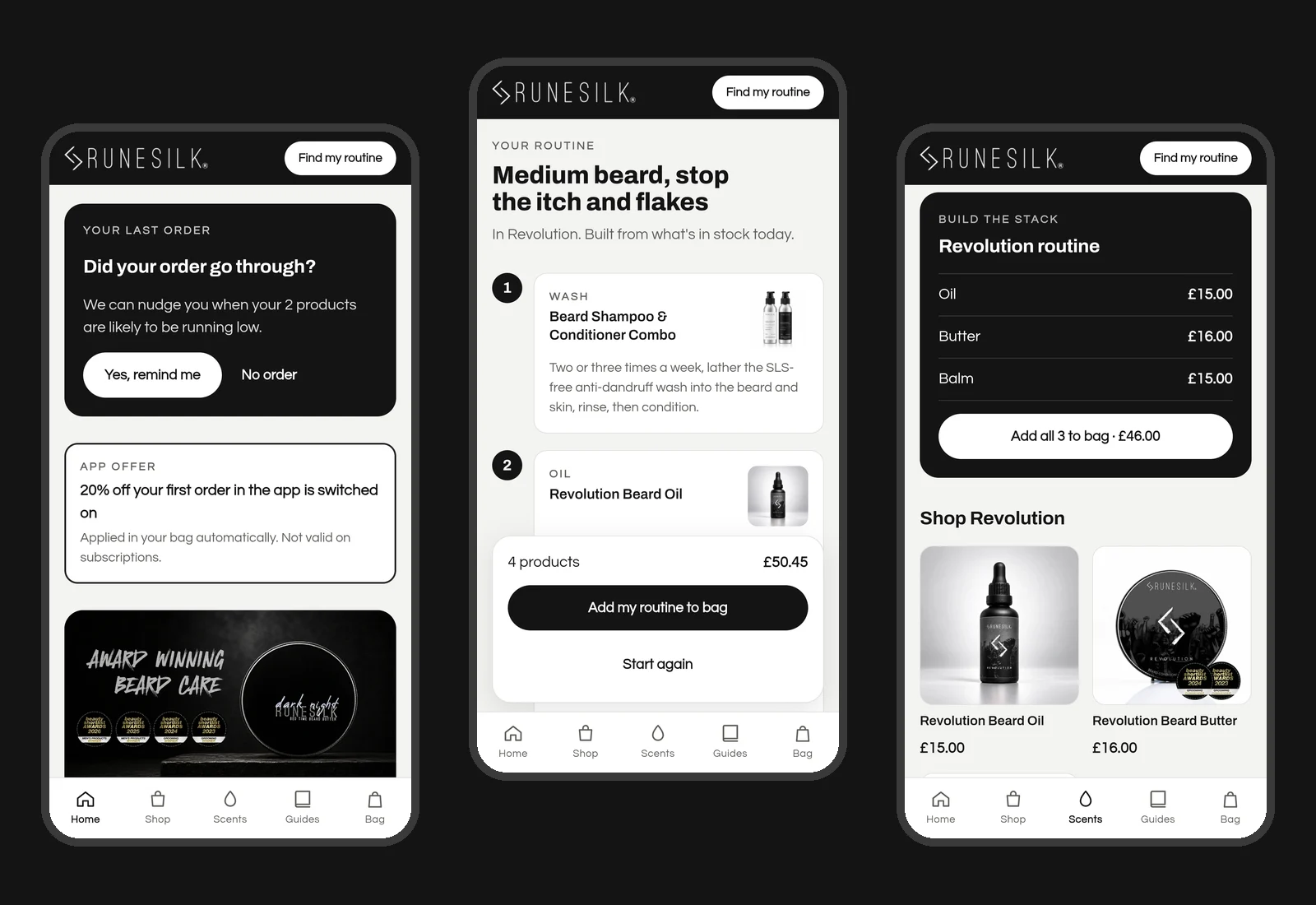
RUNESILK Beard Portal
Installed from runesilk.com on iPhone and Android.
Project context: RUNESILK was created and is operated by Daniel Jones, founder of Cape Wired. The app was built for RUNESILK's own customers first, to test the web app approach Cape Wired now offers other Shopify stores. The RUNESILK store redesign case study covers the SEO and product work that came before it.
At a glance
A Shopify app built around how customers reorder
The app launched to RUNESILK's customer list on 5 November 2026. Everything in it comes live from the Shopify store, and every order still goes through Shopify's own checkout. Results will be added here once there's enough data to report honestly.
11
Scents, each matched to a routine
Every oil, butter and balm grouped by scent, so a whole routine can match.
3
Questions to a full routine
The routine finder builds a routine from what's in stock that day, then adds it to the bag in one tap.
8 to 10 weeks
Reorder reminders
Timed to how long each product lasts, adjustable from 4 to 12 weeks, with an optional push notification.
0%
App store cut on orders
Orders go through Shopify's normal checkout, with discounts, shipping and subscriptions as usual.
The challenge
Customers liked the products, but didn't always come back
Beard oil, butter and balm run out every couple of months, but nothing reminded customers when. Coming back meant starting again from the homepage, and choosing between eleven scents and several product types is a lot to ask on a phone.
The aim was to make choosing a routine and reordering easier, without rebuilding the store or paying for a native app customers would have to find in an app store.
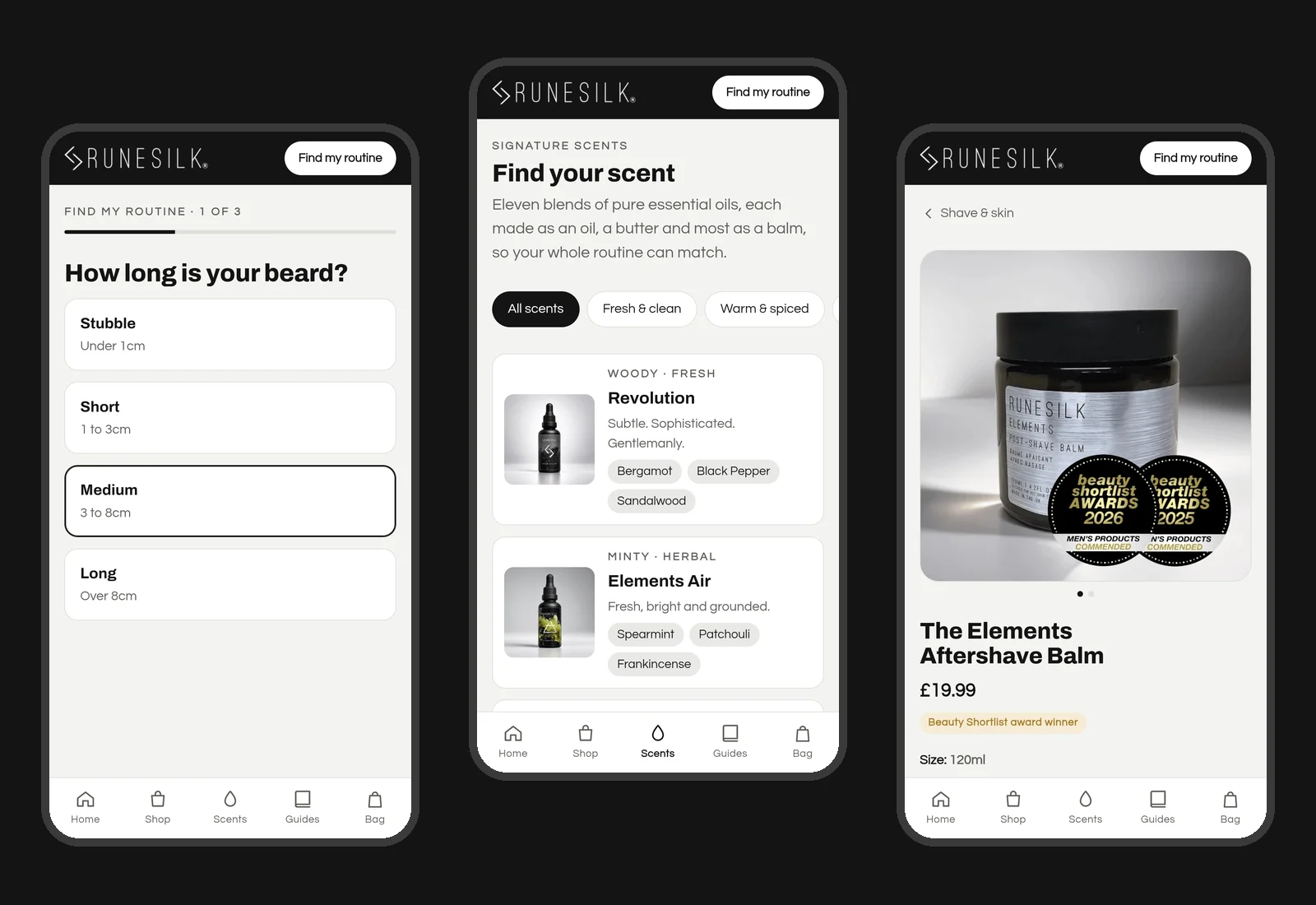
Routine finder, scent finder and product page in the RUNESILK app.
Forgotten reorders
Customers ran out and only came back if they remembered, or saw an email at the right moment.
Too much choice on a phone
Eleven scents across oils, butters, balms and washes is hard to browse on a small screen.
Native app costs
A native app means App Store review, two codebases and ongoing fees: too much for a first test.

The idea
An app that helps between orders
Rather than copy the website into an app, the app was built around three jobs: help a new customer choose, make a full routine one tap, and remind them before they run out.
It's a web app (a PWA). Customers install it from the website to their home screen, it opens full screen like any other app, and it can send notifications. The Shopify store stays exactly as it was.
- Choose: a three-question routine finder and a scent finder.
- Buy: one-tap stacks and routines, through Shopify's own checkout.
- Come back: reorder reminders, push notifications and an app-only first-order offer.
- Measure: installs, adds to bag and orders tracked from day one.
What was built
The features inside the app
Design, development, copy and setup were done by Daniel Jones, with Claude used to speed up the build. Products, prices, stock, guides and the bag all come live from Shopify.
Find my routine
Three questions (beard length, main concern, scent) build a step-by-step routine from what's in stock, with one button to add it all.
Build the stack
Every scent page offers the matching oil, butter and balm together, with the total shown and one tap to add all three.
Scent finder
All eleven blends with their notes, filtered by fresh, warm, calming or unscented.
Reorder reminders
After checkout the app asks if the order went through, then reminds the customer when each product is likely to run low.
Push notifications
Optional notifications for reminders and deal alerts, sent at sensible times and holding no product or personal details.
App-only welcome offer
20% off the first order in the app, applied in the bag automatically and capped in Shopify.
Beard care guides
The store's guides read inside the app, with the products each guide mentions listed underneath.
Measurement
Google Analytics events for installs, home screen opens, adds to bag by feature, checkout and reminders, plus a hidden note on every Shopify order placed in the app.
Seasonal moments
A built-in calendar switches on Bonfire Night, Black Friday early access for app users and Christmas messages on the right dates.
What we'll measure
Results added as they come in
The app went out to RUNESILK's customers by email on 5 November 2026. From day one, Google Analytics records installs (people opening the app from their home screen), which features lead to an add to bag, and checkouts, while Shopify marks each order placed in the app.
The numbers to watch: how many customers install it, how many come back through a reminder, how often a stack or routine fills the bag, and how many first orders use the app offer.
This page will be updated with real figures once there's a fair amount of data, rather than early numbers that don't mean much yet.
It builds on the earlier store work: the RUNESILK redesign created the product pages and guides the app now draws from.
How it's measured
Installs are counted as opens from the home screen, because iPhones don't report installs directly.
Orders placed in the app are tagged in Shopify and in Google Analytics, so they can be compared with orders from the website.
Commercial reality
An app without an app-sized budget
The app was built while RUNESILK kept trading, using the store and content that already existed.
Constraint
No second catalogue
Keeping products and prices in two places would have gone wrong quickly.
Response
Live from Shopify
The app reads products, stock, guides and the bag straight from the store, so there's nothing to update twice.
Constraint
App store cost and review
Native apps mean Apple review, developer accounts and two codebases.
Response
Web app first
Installed from the website in seconds on iPhone and Android, with the option to list it in Google Play and the App Store later.
Constraint
Checkout and payments
Rebuilding checkout would have put payments, discounts and subscriptions at risk.
Response
Shopify's own checkout
The bag hands over to Shopify's checkout, so payments, discount codes, shipping and subscriptions work exactly as on the website.
Key learning
An app doesn't need to copy the website to earn its place
The useful part isn't a smaller version of the store. It's the jobs a website does badly: helping someone choose, making a repeat order quick, and reminding them at the right time.
Because it runs on the existing Shopify store, the same approach works for other stores without rebuilding anything or changing how orders are handled.
Results from the launch will be added to this page as they come in.
Your store, as an app
Could your customers reorder in one tap?
Cape Wired turns existing Shopify stores into installable apps, starting with a web app and adding Google Play and the App Store when it makes sense.
Features and timings depend on the store, its catalogue and how customers buy. On iPhone, customers install web apps from Safari with Add to Home Screen.