
RUNESILK case study
From overlooked product to search-led growth
How a four-week Shopify, SEO and GEO project turned an underperforming anti-dandruff beard shampoo into a focused organic growth opportunity, supported by a successful launch through Amazon FBA.
Project context: RUNESILK was created and is operated by Daniel Jones, founder of Cape Wired. This internal brand project provided a real commercial environment in which to test the same Shopify, SEO, content, GEO and marketplace methods Cape Wired applies to product-led businesses.
Early performance
Measurable movement across search, sales and marketplaces
The core Shopify, SEO and GEO project was completed in four weeks. The figures below reflect August — RUNESILK's first full month of trading since launch — with ten days of August still remaining when these figures were recorded, tracked across search, direct sales and AI visibility. See "How to read the figures" further down the page for how the reporting periods relate to each other.
The challenge
A strong product that was not receiving enough attention
RUNESILK's SLS-free anti-dandruff beard shampoo had a clear purpose, a specialist formula and independent award recognition, but sales were not reflecting its potential — and competing head-on for broad terms such as "beard oil" would have meant entering an established, crowded search market already dominated by larger competitors' authority, content libraries and advertising presence.
The opportunity was not to shout louder about another beard-care product. It was to become more useful around a specific problem.
Underperforming sales
The shampoo had a strong formula and proposition, but monthly unit sales were lower than expected.
Crowded category terms
Generic beard-care keywords were highly competitive and dominated by established brands.
Theme limitations
The existing Shopify theme restricted how much useful product, education and comparison content could be presented.

The strategic idea
Focus on the customer's problem, not only the product
The strategy centred on beard dandruff, visible flakes, itching and dry skin beneath the beard. These were real concerns that customers were actively researching, but the available information was often generic, fragmented or focused on scalp care.
Rather than create a single sales page and expect it to rank, the project built an interconnected information system around the problem. Educational articles answered early research questions, comparison content helped users evaluate solutions, and the product page became the commercial destination.
- Lead with a clearly defined customer problem.
- Answer informational questions before asking for a sale.
- Connect articles, landing pages, collections and products.
- Give search engines and AI systems clear, consistent context.
- Build useful product pages beyond the theme's default limits.
Work completed
One coordinated Shopify, SEO, GEO and marketplace project
Strategy, research, copy, design, imagery, development, implementation, Amazon listing work and measurement were completed by Daniel Jones without an external development team.
Shopify redesign
The website's visual hierarchy, navigation and key commercial journeys were overhauled to create a more focused ecommerce experience.
Custom Liquid development
Custom sections were created for cosmetic product and collection pages instead of relying on the theme's limited default templates. Claude was used to accelerate parts of this workflow, while direction, testing and deployment remained founder-led.
Product-page rebuild
The shampoo page was expanded with formula information, use cases, comparisons, routines, quick facts, FAQs and stronger purchasing context.
Content cluster
An eight-part beard-dandruff article cluster was produced — full list below.
On-page and technical SEO
Titles, headings, metadata, internal links, indexation, structured content and page relationships were reviewed and improved.
GEO and AI visibility
Copy was structured to make the brand, problem, product attributes and supporting evidence easier for AI-powered search systems to understand.
Conversion improvements
Product benefits, trust signals, comparison information, routines and calls to action were positioned to reduce uncertainty.
Measurement setup
Google Search Console, analytics reporting and AI visibility monitoring were connected or corrected to establish an evidence base for continued optimisation.
Amazon FBA launch
Stock was prepared and sent into Amazon FBA, supported by a new Amazon listing designed to give the product an additional route to market.
View the eight-part beard-dandruff content cluster
- Best Beard Shampoo for Dandruff in the UK
- Climbazole in Beard Shampoo: What Does It Do?
- Beard Dandruff vs Dry Skin
- How to Get Rid of Beard Dandruff Without Shaving
- SLS-Free Beard Shampoo: Why It Matters for Facial Skin
- How Often Should You Wash Your Beard?
- Best Beard Care Routine for Itchy, Flaky Beards
- Do You Need a Beard Conditioner?
Performance evidence
Commercial, search and AI visibility moved together
The early results suggest that clearer positioning, deeper product content and problem-led educational pages began increasing discovery while supporting product sales across both the RUNESILK store and Amazon. The additional screenshots below track how that discovery has continued into August, RUNESILK's first full trading month.
Tracked AI-search visibility
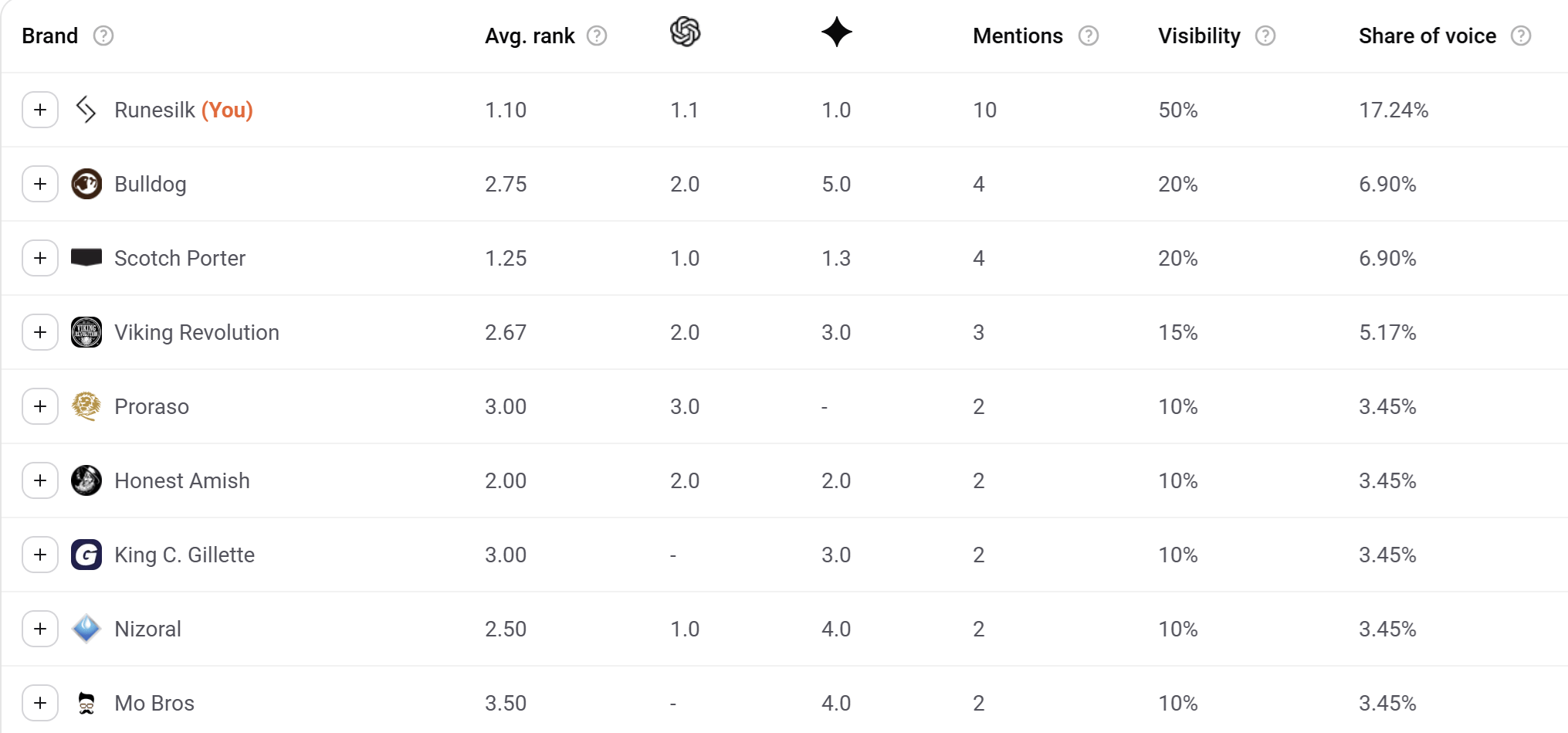
- Brand visibility50%
- Share of voice17.24%
- Average rank1.10
- Mentions tracked10
- Lead over nearest named competitor+10.34 points
This is the most current tracked snapshot, and sits slightly below the 62.5% visibility and 20.62% share of voice recorded in the earlier snapshot shown below. RUNESILK still holds the top average rank in the table and leads the nearest named competitor by over 10 points — a strong position to be defending this early in the campaign. These figures relate only to the prompts, competitors and AI platforms included in the Ubersuggest project during the tracked period and do not represent RUNESILK's share of all AI search.
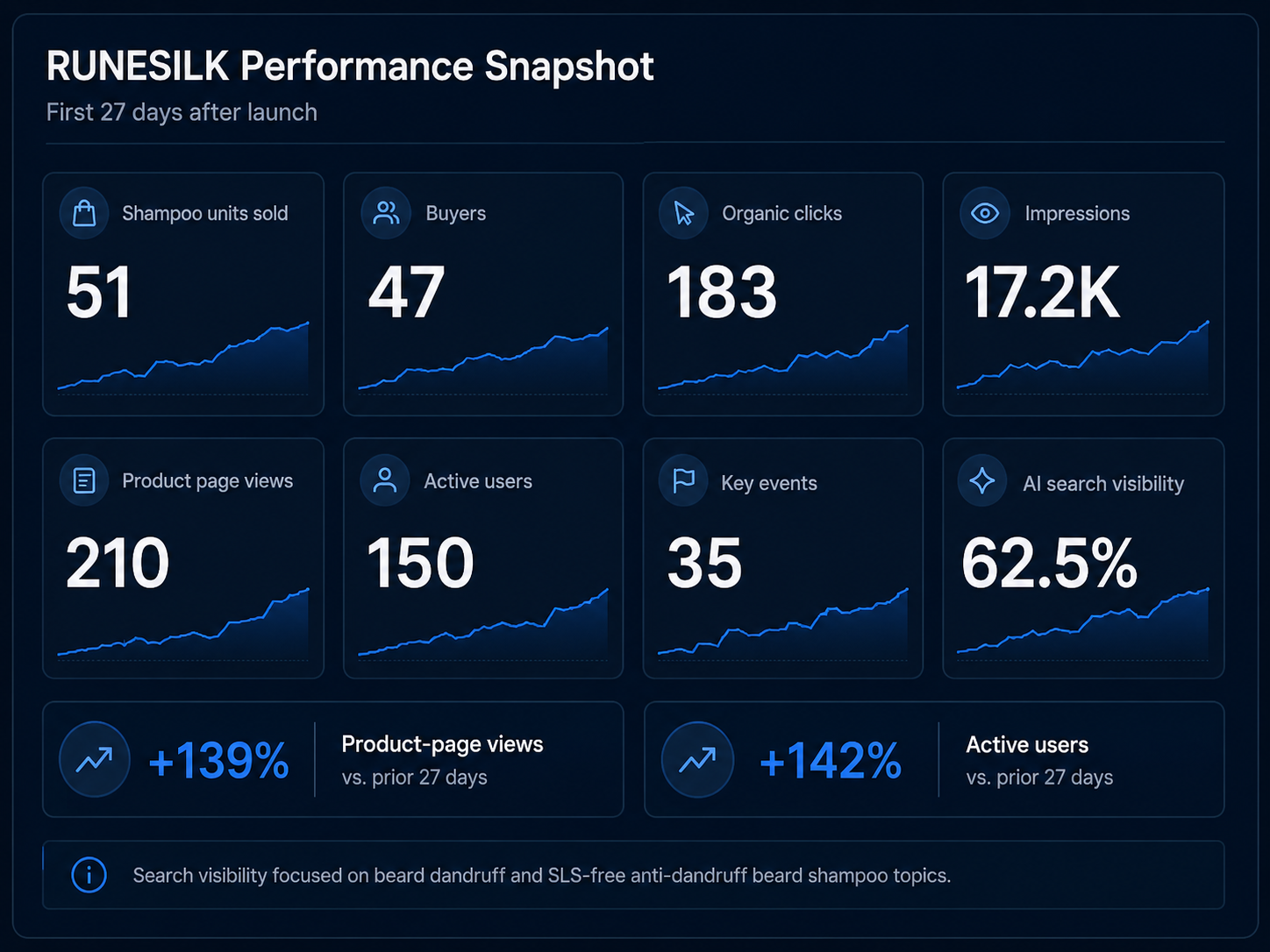
First 27-day performance snapshot
A visual summary compiled from Shopify sales data, Google Analytics, Google Search Console and Ubersuggest during the initial 27-day tracking period. It is a representative summary rather than a screenshot from one analytics platform, and predates the more recent tracking shown above.
28-day search impressions and clicks
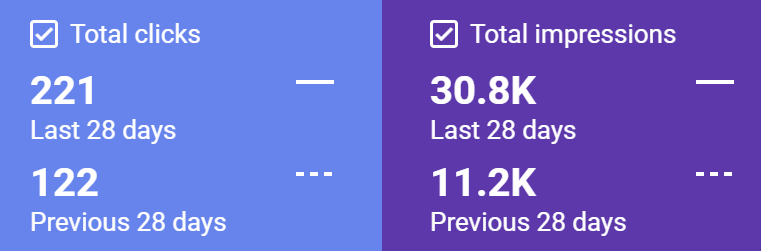
Impressions rose to 30,800 and clicks to 221 over the most recent 28 days, up from 11,200 impressions and 122 clicks in the prior 28-day period.
AI-generated summary of the account
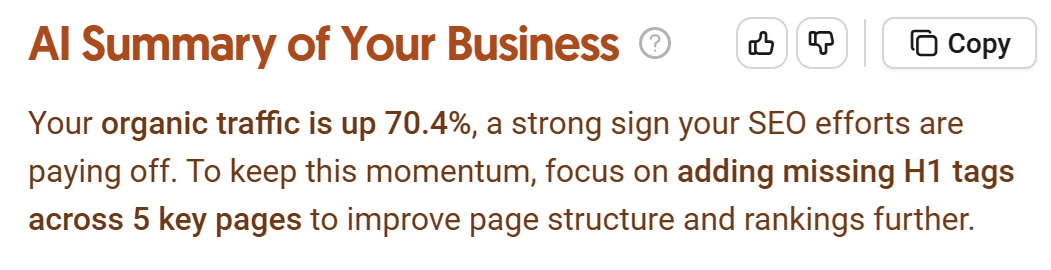
An automated summary of the account's search performance flagged a 70.4% rise in organic traffic and recommended adding missing H1 tags across five key pages as a next step — an action item that will feed into ongoing optimisation rather than this initial project.
Channel expansion
Strengthening the owned store while testing Amazon FBA
The Shopify store remained the central source of product education, brand authority and customer experience. Amazon FBA was introduced as an additional purchasing channel for customers who prefer the Amazon marketplace and its fulfilment network.
Sold through the RUNESILK website in August to date, alongside continued growth in search impressions and new-customer acquisition.
Sold through Amazon in August to date — with ten days of the month still remaining — contributing to a 194% uplift in Amazon revenue for August against the pre-launch baseline.
What changed
The shampoo became part of a larger discovery journey
Search users no longer had to discover RUNESILK through a generic product page alone. They could enter through educational content, compare beard-specific solutions, understand the role of ingredients such as Climbazole and Bisabolol, and move naturally towards the product. Over the most recent 28-day period, Google Search Console recorded 30,800 impressions and 221 clicks, up from 11,200 impressions and 122 clicks in the 28 days before that, with the homepage, beard-dandruff guide, shampoo landing page and shampoo product page among the leading destinations.
Analytics also recorded 210 shampoo product-page views and 150 active users, representing increases of 139% and 142% respectively against the preceding comparison period. New-customer acquisition rose by 358% over the most recent 60-day trailing window, suggesting the additional discovery is bringing in new buyers rather than only repeat purchases.
The subsequent Amazon FBA launch added another route to purchase. With ten days of August still remaining, 57 units had sold through Amazon and 77 through the RUNESILK website, alongside a 194% uplift in Amazon revenue for the month against the pre-launch baseline.
How to read the figures
Google Search Console had only recently been connected, so its "previously zero" comparison reflects a lack of earlier data within that report, not a lack of prior organic traffic. Analytics tracking was corrected during the same period, so the product-page comparison is useful directional evidence rather than a final long-term benchmark. The 30.8K/11.2K Search Console figures compare two adjacent rolling 28-day windows rather than the original tracked period referenced elsewhere on this page, so treat them as a like-for-like trend rather than a direct addition to earlier totals.
The 194% Amazon revenue uplift compares August-to-date Amazon revenue with the pre-launch baseline, recorded with ten days of August still to run — the final figure for the month will differ once trading is complete. Website and Amazon unit totals are reported separately and should not be added together into a single conversion or uplift number.
Commercial reality
Built without an agency-sized budget or development team
The project was completed while RUNESILK continued trading and Daniel continued handling the day-to-day responsibilities of operating the business.
Limited resources
There was no external development team and no large production budget. Work had to be commercially prioritised and delivered efficiently.
Operator-led execution
Strategy and implementation were handled together, reducing handovers and allowing decisions to be tested directly against the needs of the live store.
Theme restrictions
The existing Shopify theme did not provide the content depth or flexibility required for the new product and collection experience.
Custom sections
Purpose-built Liquid sections made it possible to create richer landing pages without replacing the entire Shopify setup or adding unnecessary applications.
New marketplace channel
Launching through Amazon required stock preparation, fulfilment planning and marketplace content alongside the wider Shopify and SEO project.
Phased Amazon FBA launch
Initial inventory was sent to Amazon FBA to test marketplace demand while retaining the RUNESILK website as the core brand and education platform.
Key learning
Smaller brands do not always need to compete for the biggest term
A narrower customer problem can create a stronger commercial opportunity than a broad, highly contested category keyword.
By combining a useful content cluster with a detailed product experience, RUNESILK created more ways for customers, search engines and AI systems to understand why the product existed and who it was designed to help.
Adding Amazon FBA demonstrated that owned-store optimisation and marketplace expansion do not have to be competing strategies — the website can build authority and educate the customer while a marketplace provides an additional route to purchase. The first 27 days were only the starting point; with August still in progress and new-customer growth already up 358% over the trailing 60 days, search visibility, rankings, direct sales, Amazon performance and AI mentions will continue to be reviewed regularly as the project develops.
Your ecommerce opportunity
Is a strong product being overlooked in your store?
Cape Wired helps product-led businesses identify clearer search opportunities, improve Shopify content and develop practical routes to market across owned stores and selected ecommerce platforms.
Results vary between businesses and depend on factors including market demand, existing authority, implementation, competition, channel conditions, measurement quality and the time available for content and marketplace listings to mature.