

LowCostBeer case study
From ageing ecommerce asset to brewery-led Shopify business
How an acquired WooCommerce store was rebuilt on Shopify, cleared of lingering domain-reputation warnings and repositioned around rescued beer, direct brewery relationships and curated Showcase Boxes.
Transformation at a glance
A faster platform and a clearer commercial direction
Not every important ecommerce result appears as a percentage. The initial priority was to create a stable operating platform, remove barriers to customer trust and make it easier to develop the business.
The starting point
An established business held back by its ecommerce platform
LowCostBeer already had a recognisable proposition: discounted, short-dated, surplus and clearance craft beer. The opportunity was clear, but the ageing WordPress and WooCommerce build behind it was slow, heavily dependent on old plugins and constrained by poor source data — loading a single product page in the back end could take a minute or two before it could even be edited.The first task was not cosmetic. The business needed an ecommerce foundation that could keep pace with a constantly changing beer catalogue.
Slow, legacy technology
Routine product creation and catalogue work were delayed by a sluggish WooCommerce back end, old plugins and rising technical debt.Poor source data
Catalogue and supplier information required review rather than a straightforward automated migration.Damaged reputation
Historical malware records continued to influence external security assessments of the domain.Live trading pressure
The store needed to continue serving customers while the new platform was prepared.One person, full accountability
Strategy, migration, design and implementation were handled directly, with no handoffs between departments or account managers.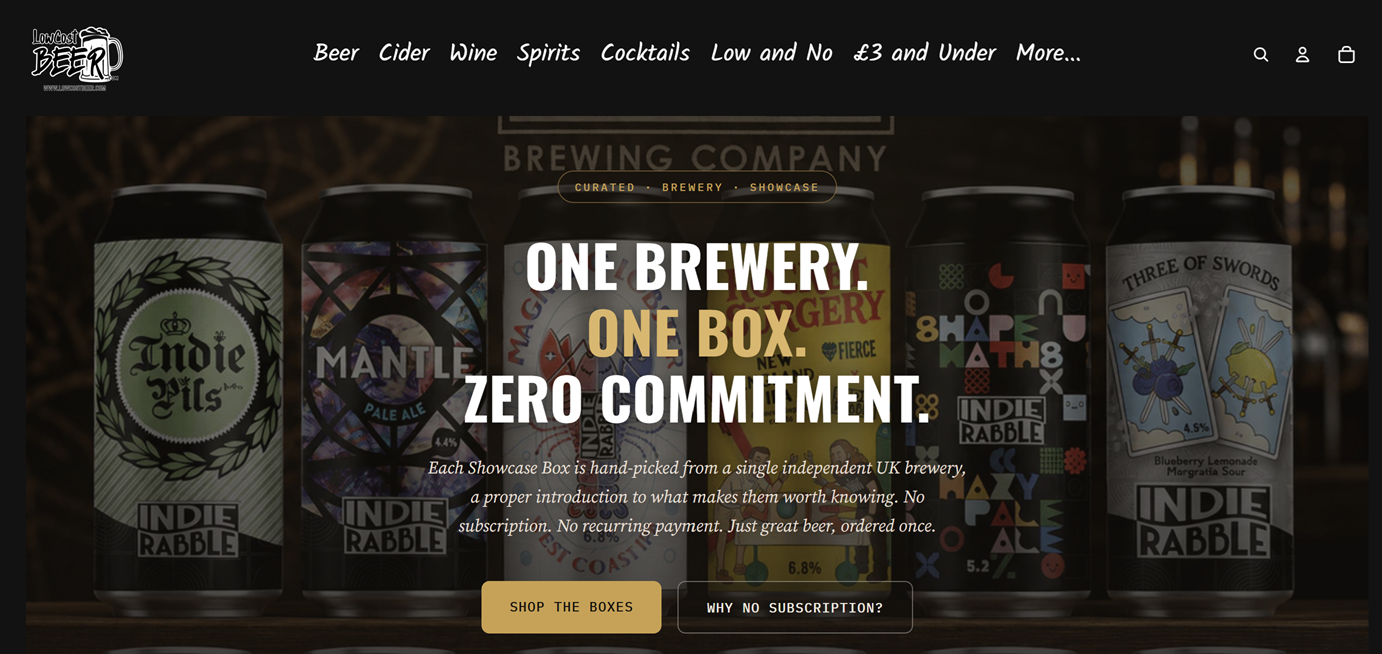
Domain-reputation remediation
A historic malware incident was still affecting the new business
The malware problem was historical rather than an active infection inherited by the new Shopify store, but outdated warnings remained within third-party security and reputation databases — recent reviewers were still encountering or reporting those flags, and the business saw a noticeable decline in sales while they remained unresolved. VirusTotal was used to identify the providers recording negative assessments, each of which was then contacted directly, supplied with evidence and asked to review the domain as a false positive. The process took approximately six weeks before the outdated warnings had been removed across the affected services.Scope of the work
This was a practical investigation and reputation-remediation process connected to the ecommerce acquisition. It is not presented as a standalone cybersecurity service.Why Shopify
Reduce maintenance and make daily ecommerce work faster
The decision was not based on platform fashion. Shopify better matched the operational needs of a product business with frequent stock changes, a large catalogue and no internal development department.
Faster product management and operations
New beers and stock changes could be managed without waiting for slow WooCommerce screens or troubleshooting plugins, freeing up time for products, customers and suppliers rather than platform maintenance.Lower technical overhead
Hosted infrastructure reduced reliance on separate hosting, security and plugin maintenance.Simpler, mobile-first checkout
Customers received a clearer, more familiar and more responsive purchasing journey, with a stronger foundation for browsing and buying on mobile devices.Expandable content
Custom Liquid sections made it possible to improve collections, product pages and promotional landing pages over time.The migration
A one-week rebuild followed by continuous catalogue improvement
The essential storefront was rebuilt quickly so the business could move away from its unstable operating environment. The wider catalogue, collection structure and content continue to be improved as an ongoing programme.
Acquisition and review
The business was acquired in May 2025. The existing website, catalogue, hosting, supplier information and customer journey were assessed.Core Shopify build
The main storefront, navigation, product structure, checkout experience and essential operational systems were rebuilt in approximately one week.Migration and redirects
Products, collections, important URLs, content and tracking were transferred or rebuilt with appropriate redirect and SEO considerations.Reputation remediation
External security records were investigated and false-positive reviews were requested from the relevant providers.Ongoing catalogue development
Around 1,000 products are now live. Collection restructuring, content improvement and product administration remain active because stock changes constantly.Before and after
From functional clearance shop to a clearer product-discovery brand
The redesign retained LowCostBeer's value proposition while creating more room for product discovery, brewery storytelling and a stronger visual identity.
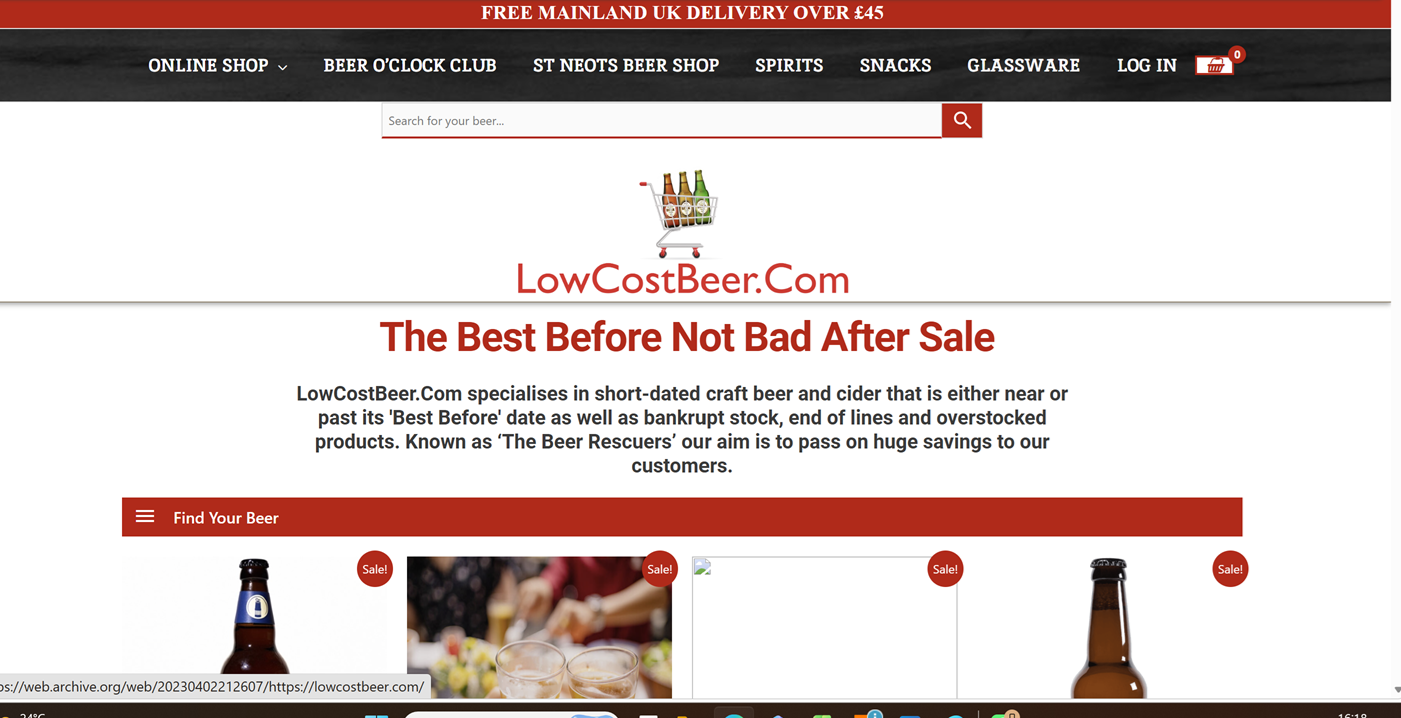
Former WooCommerce experience
A dated presentation, slower operating workflow and limited flexibility for new commercial concepts.Current Shopify experience
A darker, product-led storefront with clearer navigation and a prominent Brewery Showcase proposition.Commercial repositioning
Keep the value proposition while giving customers more reasons to explore
LowCostBeer remained focused on discounted, short-dated, surplus and clearance craft beer — giving customers access to interesting products at lower prices while helping prevent viable beer from being wasted. The next stage was to complement clearance stock with products and experiences that could not be reduced to price alone.- Rescued and end-of-line beer at accessible prices.
- A broad catalogue spanning breweries and beer styles.
- Direct brewery buying where commercially appropriate.
- Curated boxes offering a structured discovery experience.

Brewery Showcase Boxes
One brewery. One box. Zero commitment.
At the beginning of 2026, LowCostBeer began building direct brewery relationships, giving customers a structured way to discover independent producers one brewery at a time.
Single-brewery discovery
Each box focuses on one independent brewery and introduces customers to a range of its beers without a subscription or recurring commitment.
Flexible box values
Showcase Boxes generally range from £35 to £65 depending on the brewery, beer selection and product value.- Ampersand
- Mourne Mountains
- Black Iris
- Atom Beers
- Wilde Child
- Pretty Decent
- Siren Craft Brew
- Neonraptor
- TRACK Brewing
- Bearwood Brewing
- Tartarus
- Brew York
- Sureshot
- Indie Rabble
- Goodh & Skinner
- Only With Love
- Brewing Brothers
Supplier development
Buying direct created commercial and creative opportunities
Buying through wholesalers remained useful, but direct brewery relationships made it possible to negotiate stronger discounts in some cases, build a proposition around the breweries themselves, and understand upcoming stock, priorities and available ranges ahead of repeat Showcase Boxes.- Potentially stronger buying margins.
- Access to a broader or more relevant brewery range.
- Campaigns built around a clear brewery story.
- A stronger relationship between retailer and producer.
Commercial and operational outcomes
A business that is easier to operate and better placed to evolve
The project is ongoing, so the strongest early outcomes are operational reliability, catalogue capacity, improved customer journeys and the creation of new commercial formats.
Faster daily administration
The store moved away from product screens that could take one or two minutes to load and into a more responsive Shopify workflow.Faster storefront and checkout
The migration materially improved browsing, product access and the path through checkout.Approximately £75 AOV
Raising the free-delivery threshold from £50 to £75 contributed to a higher average basket while preserving a clear delivery incentive.Around 1,000 live products
The Shopify store now supports a large and frequently changing catalogue across beer, cider and related drinks categories.Historic warnings removed
The false-positive remediation process removed an inherited source of customer hesitation and external reputational risk.17 Showcase breweries
The direct-brewery strategy created a repeatable new product format that can grow as further brewery relationships develop.Delivery constraints
Rebuilding a live ecommerce business without an internal team
The work was completed alongside the operational demands of LowCostBeer and other businesses. That meant prioritising the changes that would remove risk and improve daily performance first.
Lean, founder-led delivery
Every decision was judged on commercial value delivered rather than justifying an agency-sized budget, with migration, design, SEO, supplier outreach and ongoing store development all completed without an internal specialist team.Live, constantly changing store
Customer access and order continuity had to be protected during migration, while a constantly changing product range meant catalogue development could not be treated as a one-off task.Limited supplier records
Supplier and product information required manual review and ongoing enrichment.Damaged domain history
The new site inherited external reputation problems created before the acquisition.Key learning
A migration creates value when it changes how the business operates
Replacing WooCommerce with Shopify was only one part of the work. The greater value came from removing friction, restoring trust and creating enough operational headroom to test new ideas — the Brewery Showcase Box programme would have been harder to develop on a platform where routine catalogue work was already consuming too much time. The project demonstrates how an ecommerce acquisition can be improved through a combination of technical recovery, platform simplification and commercial repositioning.Your ecommerce platform
Is your current store making the business harder to operate?
Cape Wired helps product-led businesses rebuild, migrate and improve ecommerce stores with practical attention to platform performance, customer journeys, SEO and daily operations.The LowCostBeer catalogue, collection structure, supplier network and Showcase Box programme continue to evolve. This case study reflects the project status and confirmed figures available in July 2026.