Cape Wired · Shopify & AI Integration
Shopify just turned every
AI chat into a storefront.
What Agentic Storefronts actually changed in March 2026, and what it means for a store selling into ChatGPT, Copilot, and Google AI Mode right now.
For most of the last decade, getting a Shopify store in front of new customers meant the same handful of channels: Google Shopping, Meta ads, organic search, maybe a marketplace listing. In March 2026, a new channel opened up that didn’t exist twelve months earlier — and it isn’t a website at all. It’s a conversation.
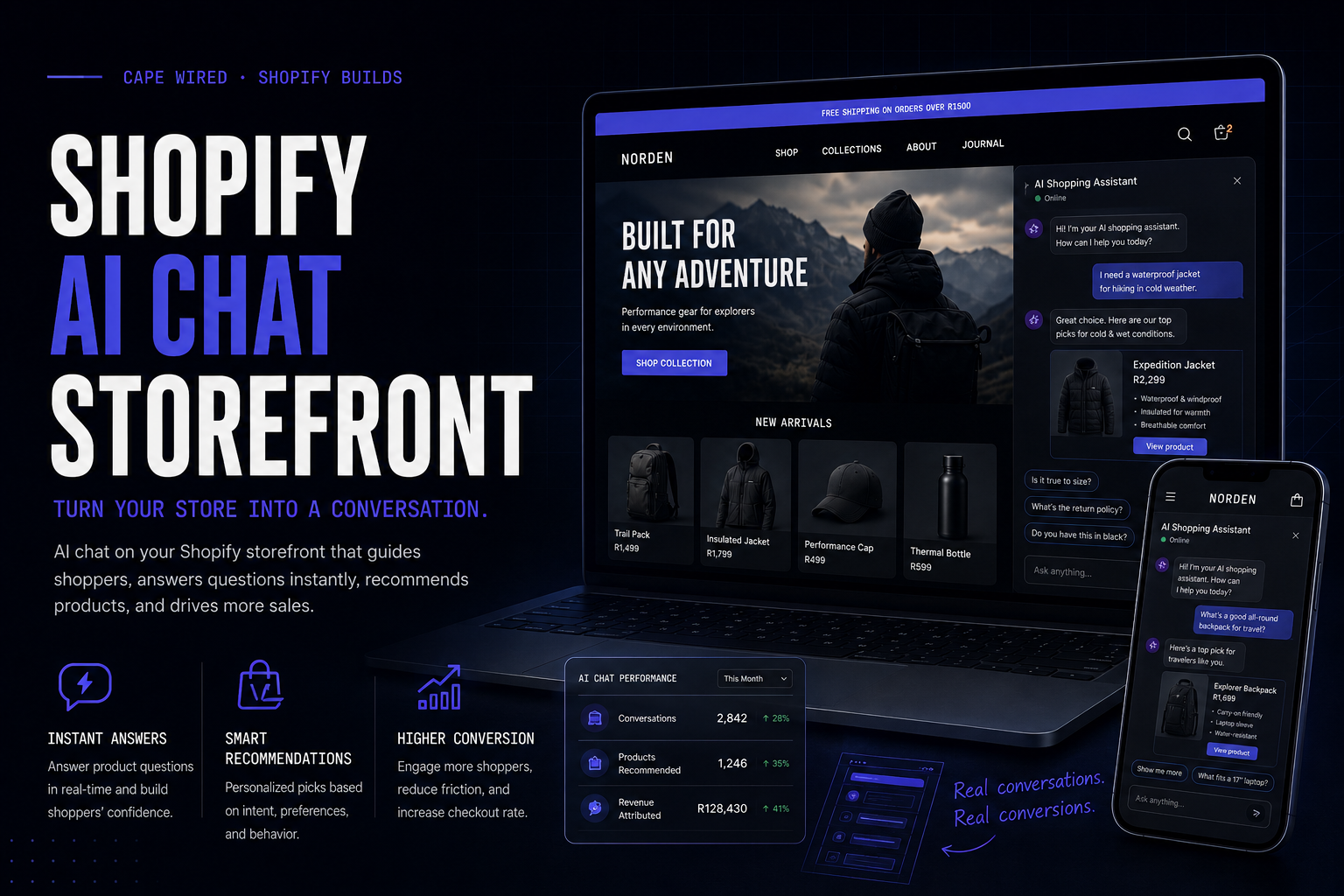
Shopify rolled out Agentic Storefronts, a feature that automatically connects a merchant’s product catalogue to ChatGPT, Microsoft Copilot, Google’s AI Mode, and the Gemini app. Customers can now discover and purchase products directly inside those AI tools, with the feature active by default for stores that qualify. No app to install. No separate feed to maintain for each platform. It’s switched on in the background, and for a lot of Cape Wired clients, it likely already is.
What actually happens when a customer asks an AI to shop
The shift here is less about advertising and more about how products get found in the first place. When someone asks an AI assistant for a recommendation — something like wanting navy running shorts — the AI searches available catalogues and returns a shortlist it thinks matches the request. No keyword stuffing, no bidding on search terms. The AI is reading the actual product data and deciding what fits.
What happens after that recommendation depends on the platform. With ChatGPT, the customer is referred through to the merchant’s own store checkout, either in an in-app browser or a new tab. Copilot and Perplexity, on the other hand, support buying without ever leaving the conversation, since checkout can be completed directly inside the chat. Either way, the order still lands in the merchant’s own Shopify admin, with the AI channel tracked as the source.
Why this matters more than another sales channel
Most new sales channels mean new work: a separate feed format, a different ad account, a different optimisation playbook. Agentic Storefronts runs differently — rather than building a separate integration for every AI platform, a merchant lists products once through Shopify’s Catalog, and that single feed is what gets syndicated to ChatGPT, Copilot, Gemini, and whatever AI platform launches next. Update a price or mark something out of stock, and that change reaches every connected AI surface at the same time, automatically.
That’s the operational story. The growth story is what makes this worth paying attention to right now rather than filing it under “interesting, check back later.” Shopify reports that AI-driven traffic to its merchants grew eight times over in the first quarter of 2026 alone compared to the year before, with orders originating from AI searches increasing almost thirteenfold. That’s not a rounding-error channel. That’s a new front door opening at a pace most stores haven’t adjusted for yet.
From conversation to checkout: how Agentic Storefronts route a single AI request back to your store.
What actually decides if your products get picked
This is the part most merchants miss when they hear “it’s automatic.” Activation is automatic. Visibility isn’t. AI agents surface products based on the structure and completeness of the underlying catalogue data, not on how the product page looks — merchants with complete attributes like material, size, brand, and accurate stock status appear in noticeably more AI shopping results than merchants whose data is thin.
That reframes what “good product copy” means in this channel. A line like “luxuriously soft premium cotton” reads nicely to a human but tells an AI agent almost nothing it can compare. A line specifying the actual fabric composition and weight gives the agent something concrete to match against the shopper’s question. The stores that show up consistently in AI recommendations are the ones treating their product data as a specification sheet, not just a sales pitch.
- Complete attributes win. Material, size, colour, use case, and accurate stock levels matter more here than persuasive copy alone.
- Real-time inventory is non-negotiable. An AI recommending an out-of-stock item is a fast way to lose the customer’s trust in the channel entirely.
- Reviews still carry weight. Several AI platforms factor customer reviews into ranking, the same way they’d weigh a recommendation from a knowledgeable friend.
What this changes for stores already live
If a Cape Wired-built store is already on Shopify, there’s a good chance Agentic Storefronts switched itself on already — this is an opt-out feature for eligible stores, not an opt-in one. The practical next step isn’t a rebuild. It’s an audit: are product titles, descriptions, and variant data actually structured well enough for an AI to use, or were they written purely for a human scrolling a page?
For most stores, that’s a content and data-structure job, not a development job — the kind of thing that pairs naturally with the AI product description work Cape Wired already builds into Shopify projects. For a smaller number of stores with more complex catalogues, it’s worth a proper review of how metafields are mapped before assuming the AI channel is pulling clean data.